
Share Pope John Paul Ii's obituary with others.
Invite friends and family to read the obituary and add memories.
Stay updated
We'll notify you when service details or new memories are added.
You're now following this obituary
We'll email you when there are updates.
Select your format and elements to print

IN LOVING MEMORY OF Pope John Paul Ii
Pope John
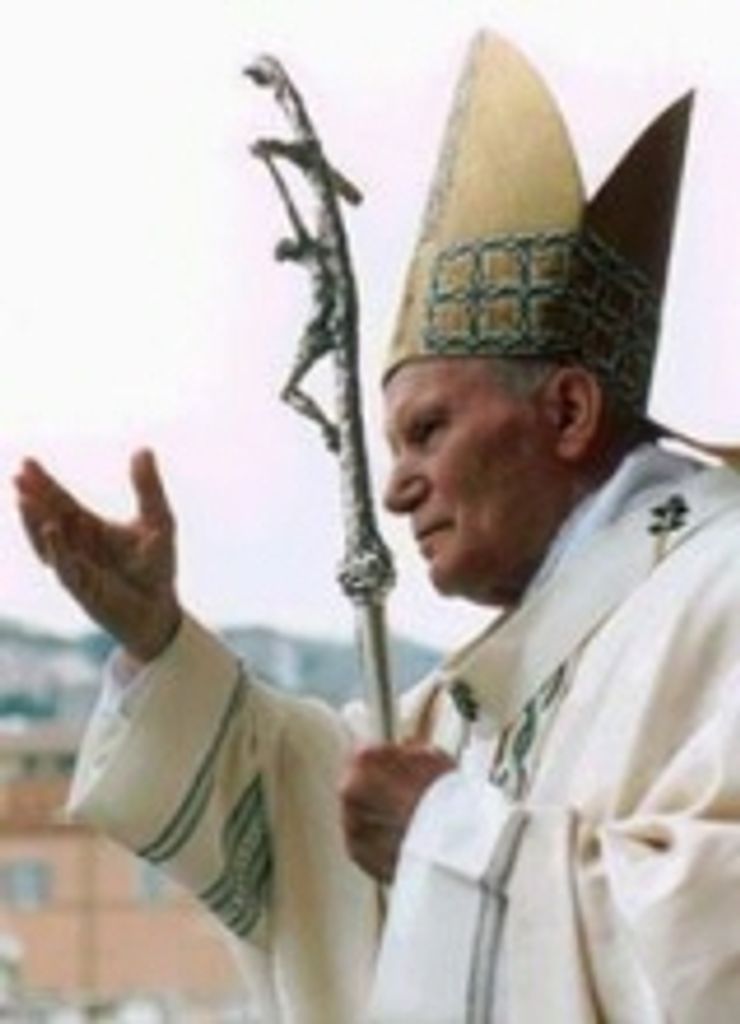
Paul Ii
May 18, 1920 — Apr 2, 2005
Pope John Paul Ii's Obituary
Please CLICK HERE to view our memorial scrapbook for Pope John Paul II.
Pope John Paul II, 84, the leader of the Roman Catholic Church for the past 26 years, died Saturday night, April 2, 2005 at 9:37 pm (Roman Time) at his Vatican apartment after a long struggle against debilitating illness.
He was born, Karol Jozef Wojtyla on May 18, 1920 in the small city of Wadowice, Poland. He was the second son born to Karol and Emilia Kaczorowska Wojtyla. His mother died in 1929, his brother Edmund, a doctor, died in 1932 and his father, a non-commissioned army officer died in 1941.
Upon graduating valedictorian from high school in Wadowice, he enrolled in Cracows Jagiellonian University in 1938, where he became active in the schools drama program. After the Nazi invasion of Poland on September 1, 1939, the occupying forces closed the university. To avoid deportation to Germany and to earn a living, young Karol found work in a quarry as a stonecutter and than in a chemical factory.
After being inspired by the writings of St. John of the Cross and St. Teresa of Avila, he entered an underground seminary maintained by Cardinal Adam Sapieha of Cracow in 1942. At this time, he was also one of the pioneers of the Rhapsodic Theatre, which was outlawed by the Nazi's. At the war's end he continued his studies at the seminary and at Jagiellonian University.
He was ordained in Cracow, Poland on November 1, 1946. He later went to Rome at Cardinal Sepiehas request to continue his studies at Angelicum University. He finished his doctorate in theology in 1948 and returned to Poland, where he served as vicar to various parishes in Cracow as well as chaplain for the university students. In 1951 he again took up his studies on philosophy and theology and later became a professor at the major seminary of Cracow and Lublin Catholic University.
On July 4, 1958, he was appointed Auxiliary Bishop of Cracow by Pope Pius XII, and was consecrated September 28, 1958 in Wawel Cathedral, Cracow, by Archbishop Baziak. On January 13, 1964, he was nominated Archbishop of Cracow by Pope Paul VI, who made him a cardinal June 26, 1967.
Pope Paul VI, died on August 6, 1978 and Cardinal Wojtyla participated in the conclave that chose Cardinal Albino Luciani of Venice, Italy as his successor on August 26th. The new pope, who had taken the name John Paul I, died unexpectedly on September 28th. Cardinal Wojtyla joined 110 other cardinals in that years second conclave. He emerged on the second day of voting, October 16th, as Pope John Paul II. He was a compromise candidate after the conclave was deadlocked over two Italian cardinals. He was the first non-Italian pope elected in 455 years and the first pope of Polish decent.
The major themes of his pontificate produced a significant body of magisterial teachings in such areas as Christian anthropology, sexual morality, social justice, human rights and the promotion of peace throughout the world. He proclaimed the year 2000 a Jubilee Year with an aim to fostering a renewed commitment to evangelization among Catholics.
His papacy was in many ways defined by his travels. He was the most traveled pope in the history of the Church. He completed 104 pastoral visits outside of Italy, which included 132 different nations and 146 visits within Italy. As Bishop of Rome, he visited 317 of the 333 parishes. He travels were aimed at the young and the poor who he knew did not have the means to visit him at the Vatican.
John Paul II is closely associated with the events that lead to the fall of communism in Eastern Europe. His visits to his Polish homeland in 1979 and 1983 bolstered Polish Catholicism and his support of the Solidarity labor movement kindled Polish resistance to communism. His moral stand against the communists helped promote a growing non-violent liberation movement which lead to the collapse of communism, democracy in Poland and other countries, the fall of the Berlin Wall, the breakup of the Soviet Union and the end of the Cold War.
He worked tirelessly for peace in many parts of the world, such as Lebanon, the Balkans, the Persian Gulf and Africa. He sought to avert the Persian Gulf War of 1991 and the outbreak of hostilities in Iraq in 2003. He advocated religious liberty and human rights in many countries such as Cuba and Nigeria. During his reign, he oversaw the establishment of diplomatic relations between the Holy See and the United States, Poland, Mexico, Jordan, South Africa, Lybia and many other Eastern European nations that were former Soviet satellites. Relations were also established with the Soviet Union in 1990 and later the Russian Federation in 1992. He was the first pope to visit the White House and he met with Presidents Carter, Reagan, G.H.W Bush, Clinton and G.W. Bush.
In 1986, John Paul II became the first pope in 2000 years to visit a synagogue. He later initiated diplomatic relations with the State of Israel when he issued a formal apology for the past misdeeds of the members of the Church and for all anti-Semitic actions by Catholics. A written apology to the Jewish people was placed by the pope in the Wailing Wall in Jerusalem during his historic trip to the Holy Land in March of 2000. He was not as successful in establishing ecumenical dialogue with the Orthodox churches as he had wished.
During his administration the Holy Father brought the long-term financial problems of the Holy See under control. He oversaw the reorganization of responsibilities of Vatican offices and the issuing of an apostolic constitution reforming the Roman Curia. He strengthen the integrity of the Catholic doctrine when he directed Cardinal Ratzinger to publish important documents on bioethics, liberation theology, the Churchs inability to ordain women as priests, reaffirmation of celibacy for priests, and same-sex unions. One of his most important initiatives was the Catechism of the Catholic Church. He approved a commission of cardinals to publish the first catechism for the universal Church in four centuries. John Paul oversaw the completion of the revision of the Code of Canon Law begun in 1959 at the direction of Pope John XXIII. He also promulgated the Code of Canons for the Eastern Churches.
During his pontificate John Paul II presided at 147 beautification ceremonies and 51 canonization ceremonies, which lead to 482 saints. He held 9 consistories in which he created 231 cardinals. He convened six plenary meetings of the College of Cardinals and presided at 15 Synods of Bishops. His principal documents include 14 encyclicals, 15 apostolic exhortations, 11 apostolic constitutions and 45 apostolic letters. He also published five books.
On May 13, 1981, a Turkish terrorist named Mehmet Ali Agca, shot John Paul II at close range as he greeted the crowd gathered at St. Peters Square for his Wednesday general audience. Following a six-hour operation he was hospitalized for 77 days. In 1983, the Holy Father visited Ail Agca in prison and forgave him for the attempt on his life.
The Holy Father maintained a highly demanding schedule even as his health declined over the years. In 1992, he had colon surgery for the removal of a non-cancerous tumor. In 1993, his shoulder was dislocated in a fall and he suffered a broken femur in another fall in 1994. In 1996, he had an appendectomy and for the past several years he has suffered from Parkinsons disease, which is a neurological condition.
A Mass of Christian Burial was held Friday, April 8, 2005 at 10:00 am (Roman Time) in St. Peters Square. Cardinal Joseph Ratzinger, dean of the College of Cardinals presided over the mass, which drew the largest gathering of dignitaries and lay people in modern times. Immediately following the mass the Pontiff's simple cypress casket was carried off the square by 12 pallbearers wearing white gloves, white ties and tails. The casket was presented to the crowd one last time before being taken into the basilica and down the Steps of Peter to the underground grotto for burial. Before the private burial service the cypress casket was placed in a second casket made of lead and a third made of elm. The outside casket bears bronze markers with his name, a cross and his papal coat of arms. It was than placed in a marble lined grave located in a small chapel between the tombs of Queen Christina of Sweden and Queen Carlotta of Cyprus. A flat marble slab bearing the late pope's name, date of birth and death covered the grave. The committal service was performed by Cardinal Eduardo Martinez Somalo, who is the Vatican Chamberlain.
On Sunday, April 3, 2005 the Pontiffs body was reposing for prelates, ambassadors, Vatican employees and other dignitaries in Clementine hall in the Vatican's Apostolic Palace. He was dressed in crimson vestments, a pair of the simple brown leather shoes he favored and a white bishop's miter with his head resting on a stack of pillows. A rosary was wound around his hands and a staff was tucked under his left forearm.
On Monday, April 4, 2005 his body was transferred on a crimson platform by 12 white gloved pallbearers who were flanked by Swiss Guards to St. Peters Basilica where it lay in state over the tomb of St. Peter, the first pope, for public viewing until Fridays mass. It was estimated that nearly 2 million people paid their last respects to Pope John Paul II.
Sources: Holy See Press Office, His Holiness John Paul II a short biography Catholic Almanac On-Line Biography of Pope John Paul II
To send flowers or plant a memorial tree in memory, please visit our flower store.
Pope John Paul Ii's Guestbook
Visits: 9
This site is protected by reCAPTCHA and the
Google Privacy Policy and Terms of Service apply.
Service map data © OpenStreetMap contributors